
- Developmental Editing
- Story Coaching
Book Promotions, Literary Agents & Query Letters: AWP 2023 Conference Notes & Lessons
Lorem ipsum dolor sit amet, consectetur adipiscing elit, sed do eiusmod tempor incididunt ut labore et dolore magna aliqua. Ut enim ad minim veniam, quis nostrud exercitation ullamco laboris nisi ut aliquip ex ea commodo consequat.

- Interview by Srishti
- Published Oct 28, 2026
- 34mins
Introduction
Hey friends!
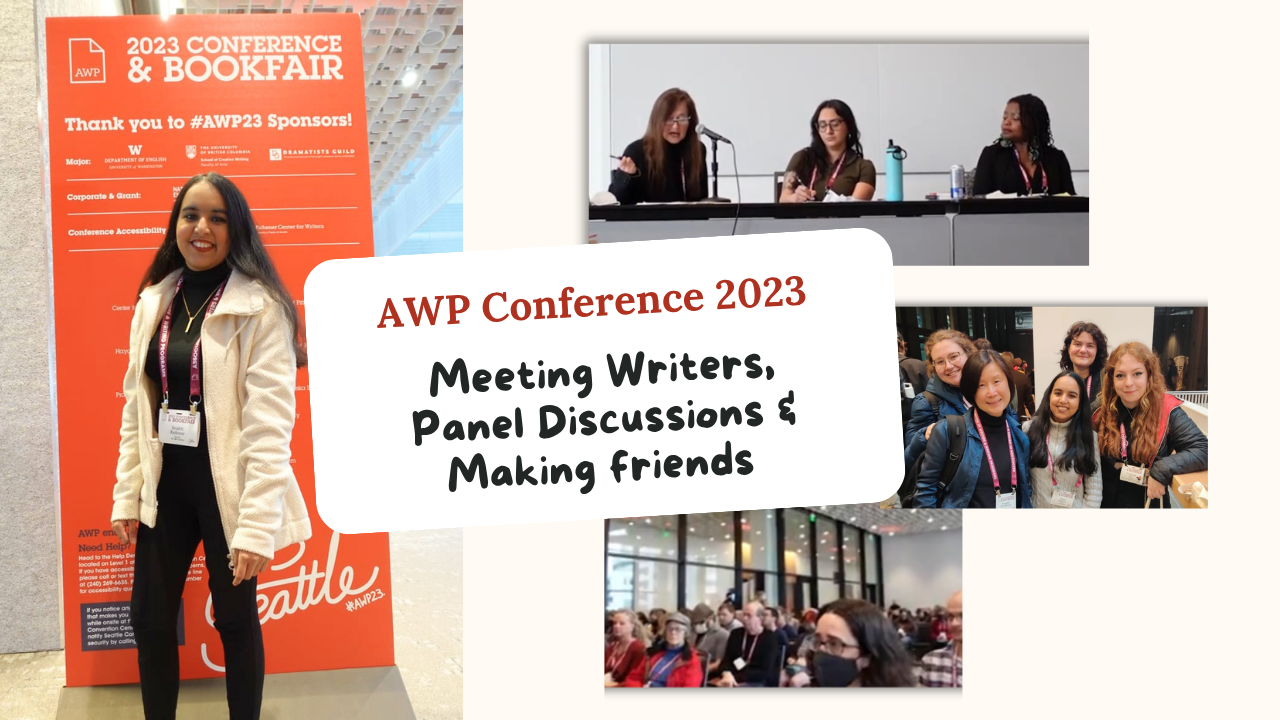
I recently attended AWP 2023, the biggest writing conference in the US. If you haven’t heard of it before, AWP stands for Association of Writers & Writing Programs. You can learn all about this annual conference here- AWP conference.
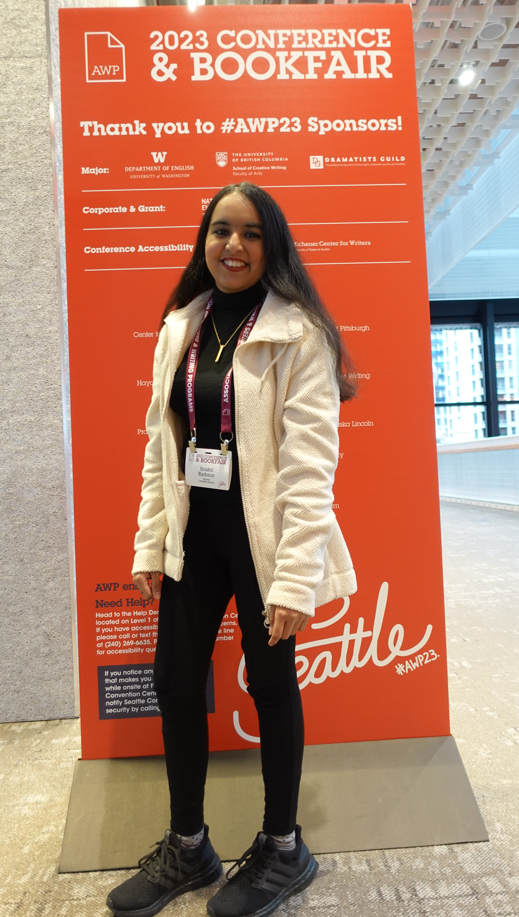
During the conference, I attended many panel discussions, took a lot of notes, spoke to numerous industry experts and made some amazing friends. When I returned, I decided to document all the information I learnt from my experience. Here is is picture of me on the first day-
Over the years I have grown and evolved as a storyteller, but my mission has remained the same. I want to help those writers who do not have access to enough finances or resources to join an MFA program.
And therefore, I’ve decided to share my learnings with all of you in this blog post. The topics here include book promotions, book prizes & contests, traditional publishing, literary agents, query letters and so much more! But before I jump into those, here are some important disclaimers.
- These are my personal notes that were originally intended to be kept private. I just wanted to organize all the mess in my notes into something I can look back upon later. So as you read, keep in mind that I’m NOT vouching for all the information given here. I’m only sharing what I have collected from various sources (i.e. panel discussions, conversations with agents, talking to other writers etc.) during the conference.
- Personally, I have not been traditionally published (yet), therefore most information here does not come from my own experience, but from the experience of others whom I met at the conference. Hence, if you feel something isn’t right, don’t come at me!! Take everything with a grain of salt.
- I have not specified the names of people with each point because I wanted to keep the focus on the information. But at the end, I’ve included a list of all the panels I attended along with the names of the panelists for your reference.
For your convenience, I’ve divided the post into three sections. Feel free to jump around or just read all the way through.
I hope you’ll find this blog post to be a helpful resource.
Oh and yes, I’m sorry for any typos that might have crept in because, as I said, this was meant to be a personal journal entry of sorts. Bear with me 🙂
Watch my top 5 lessons from AWP on YouTube
If you want to just get the highlights or want to catch snippets of the panel discussions, check out this video I made on YouTube and don’t forget to subscribe once you’re there!
PART I– Book Promotions: Investing in your book, Marketing Methods & potential mindset switch!
Q. What are the different ways to promote your book:
(4 authors on a panel talked about various ways they used to promote their books!)
- Paying for a Kirkus review
- Kirkus is an American book review magazine founded in 1933 by Virginia Kirkus. Kirkus is a credible, industry-renowned resource among authors, publishers, the media, libraries, booksellers, and readers. It is a trusted measure around the world. (source- Google!)
- Getting a Kirkus review helps provide your book credibility and your book gets taken seriously in the industry.
- Paying for a Kirkus review does not mean paying for a good review, it only means you are paying for the time the reviewers are investing & not for their opinions on your book. So, the reviews are considered to be quite fair: however, if you do get a negative review, Kirkus gives you an option to keep it private (& just use it as feedback for your writing). If you get a positive review, you can choose to publish it on the Kirkus website, followed by other places like Amazon, Barnes & Nobles, etc. and use it for promotions.
- All details at Kirkus Reviews Website.
- A Blog Tour
- A blog tour is similar to a book tour but instead of the author going to different cities, the book is sent out to different bloggers to be promoted on their respective blogs/websites.
- This is usually like word of mouth but happening on a virtual platform.
- One of the authors on the panel said that from her experience, she would not recommend blog tours because she feels it wasn’t worth the money.
- Arranging major in-person events
- You can arrange major events around different cities where you can invite a lot of people from the industry and potential readers. Having free food and cocktails is a great addition.
- One author on the panel did 3 such super successful events in different cities, throwing cocktail parties, which got people talking about her book. Although costly, she believes this is a highly recommended strategy because not only was her book the talk of the town, but she actually strengthened her relationships with the industry people due to these social gatherings.
- Entering your book for prestigious awards
- Do your research about different awards being given for the category of your book and select the most prestigious ones. Then, enter your book for these awards because if you win (or if you’re even a finalist), it helps build authority and credibility for your book, very much like the Kirkus reviews.
- Social Media Ads
- Don’t underestimate the power of Instagram and Facebook Ads because when people repeatedly see a specific Ad, they do get interested in the product. This must have happened with you too- you don’t realize you needed something until you saw it on Instagram! And this happens a LOT with books.
- But you need to make sure that your ads are targeting the right audience for your book, otherwise you may risk getting bad reviews for your book (which you don’t want).
- From my own experience, I believe that Social Media Ads would only be a good strategy if you are also complementing it with a LOT of organic marketing where people on social media are talking about your book in ADDITION to paid Ads appearing in your target reader’s feed because if it’s just Ads, your book might get buried under a lot of crap on the internet.
- Therefore, if you want to invest in Ads, I highly recommend planning an entire virtual campaign where for a specific duration, it should seem like everyone’s talking about your book!!(When I say “everyone”, I mean everyone is your target reader’s circle!!)
- Press Release
- Despite the internet, newspapers still hold immense power. Hence, having a review or a blurb of your book published in a newspaper can seriously enhance your book’s credibility and help you reach a wider audience.
- One more way is to have a press release about your book launch or your major in-person events. This could help in generating buzz around your book and potentially lead to a higher turnaround in your events.
- If you do it well, a press release might even get you featured in interviews and get you invited for other industry events.
- Book Trailers
- Just like movie trailers, you can get a short video trailer made for your book that will help in generating buzz around your release and since not a lot of books do this, it might be a way to stand out.
- However, book trailers can be expensive, therefore it is recommended only if you know you can do it very creatively & you believe you can pull this off.
- Hiring a publicist
- If you feel like you cannot do all of that on your own, you can hire a publicist. A publicist is someone who does all the marketing tasks on your behalf for a fee. 3 out of 4 authors from the panel said that they hired a publicist who charged $2k per month.
- The publicist worked on creating the marketing campaign, finding where marketing can be done, creating graphics & book trailers, reaching the bloggers etc. Hiring a publicist can be the right decision for you if you are not good at marketing, public relations and building an author brand.
💡 However, from my own experience, I would suggest being warry of hiring any publicist without prior research. Not only is it necessary for the publicist to have a lot of useful connections in the industry but they should also be willing to use it for your book and your best benefit.
- Although I am against micromanaging, if I ever hire a publicist, I would like to be overseeing everything in depth instead of blindly trusting the publicist to do the job. Sometimes, you just have to make people do their job.
- Promoting throughout the year & beyond
- A misbelief that writers have about promotions is that they believe they should only be promoting for the first 4-6 months or a year. Although it’s true that you must try to garner as much fame as possible for your book in the beginning during the launch period, you must continue to promote your book year around and keep talking about it whenever a chance arises.
- This doesn’t mean you need to spam your audience with just book promotions. But still remember that once your book is out in the market, it’s out forever! So do not shy away from promoting your book many years down the line as well.
- Consider promotional investment from the publishing house
- When you’re offered a deal with a publishing house with a decent amount of advance, you will be tempted to take it up immediately. However, it is wise to pause and think how much the publishing house is willing to invest in the promotional activities of your book.
- Because if they pay you an advance of $2K but take no responsibility of promotions, it is likely you’ll end up spending all the amount on just the promotions of your book. On the other hand, if they provide you a smaller advance, say $500, but are willing to invest a considerable amount in the promotions, then you’ll have higher chances of making a profit from this deal.
- Therefore, do not sign the book deal only based on the advance you’re getting. It is highly recommended to be transparent with the publishing house and either negotiate or get clarity on promotional activities from their end.
🧭 If you feel like you cannot afford promoting your book, one way to raise money is by crowdfunding. One author on the panel talked about it as one of the methods she used. I’m still looking into how this can be done and will share more info soon once I figure it out myself. Another method mentioned was to try getting specific grants for writers. Again, I’m still looking into this before I can share more.
My Mindset Shift- re: publishing my books!
Looking at the transparent costs of how much these authors spent on their books and knowing that they didn’t make their money back, I have had a crucial mindset shift when it comes to publishing my books.
- {Note- In this blog post, I have not shared the transparent costs (the actual figures) shared by those authors on the panel because I do not have their permission to do so in my post.}
I have understood that trying to look at my books as an investment and hoping to make a large profit out of them is just too unrealistic and an impractical goal to have.
Now one might look at this as if I’m “giving up” on the dream of passively earning from your books and being a full time writer but the truth is different from my perspective.
In fact, I have realized that my actual dream (on a very personal level) is just to keep working with stories, whether or not they belong to me. Which means I get almost the same level of satisfaction from editing stories I connect with as I get from writing my own books.
Therefore, I’ve decided to not put the pressure of being a “product” on my writing, instead I’d like to create conversation around my books and serve the stories to the world in a way that they spark joy for someone.
In a nutshell, I have personally chosen to not chase the dream of being a full time writer. If it happens, I’ll be happy and if it doesn’t happen, I’m already happy anyway!!
💡 Takeaway for you– Do not feel obligated to look at your goals the way I’m looking at mine. You are absolutely entitled to your dream and you should follow what your heart wants. But if you do want to be making a profit out of your books and go towards your dream of becoming a full time writer, I highly recommend two things- 1) Write a REALLY good book! & 2) Market the HELL out of it.
PART II- Book Prizes: Winning writing competitions & getting a publishing deal with small presses
Q. What are the benefits of submitting your story to book prizes (especially the ones that have a fee associated with them):
These are the reasons provided by representatives of four small presses.
- It’s not only the winner who gets the benefit because many times, the editors who are choosing finalists end up resonating with more stories from the shortlisted pile. And if your story is among them, the editor might want to take you on for a separate publishing deal instead of the one you submitted to.
- The fees associated with these competitions is spent in paying the first readers, editors and the judges. Therefore, in one way you are contributing to your own community and showing that you respect their time.
💡 Although I agree with this point of contribution, I would caution you when submitting to any competition or publishing house which requires you to pay a fee upfront. Please do your own research on the background of the specific company & make sure that they are authentic. Because of course you don’t want to get scammed!
- When you publish with small presses, it’s easier to build long term relationships with them and if you want to work with them again, you hold a good chance!
💡 Again, I would caution you against blindly trusting an Indie press. One way to ensure if they’re really good is to reach out and speak to other authors who have worked with them previously. Do NOT blindly believe the testimonials on their website because, think about it, they’ll only put the good experiences on the website!!
- With most University presses, MFA students do all the production work, from editing to cover design, so that means if you get rejected from a University press once, you can still apply to them after 2 years because by then, they will have all new students: all fresh pairs of eyes on your work.
- If you’re submitting to a book prize, the process of choosing winners and announcing publication works quite quickly compared to regular publishing.
Q. What are the best practices when submitting to book prizes & competitions?
Again these are the ones mentioned by the representatives of four small presses on the panel but make sure to check the specifics of the competition/prize you’re applying for.
- It’s recommended to submit early to book prizes and not on the last day of the deadline.
- If you’re selected as a finalist, have a pitch ready! Because the process moves way faster than regular publications, you will be needed to provide a comparative title a.k.a. comp title for your book. (if you’re clueless, don’t worry, I’ve included a whole section on comp titles below!)
- Frontload your manuscript with your best work! This means that, unless specifically mentioned in the guidelines, don’t restrict yourself to only submitting the first chapter. Maybe your third chapter is where the good stuff happens, then go ahead & submit that!
- If it is a blind reading competition (where judges are not supposed to know your name when reading your story), don’t include your name or any personal information on the document of your writing because this will automatically disqualify you.
- Most small presses will not publish stuff that is showing judgemental themes such as misogyny, bias against LGBTQ+ community etc. Hence, make sure your work does not glorify any such themes because for one, that would make you a bad person and two, you’ll surely be disqualified!
- Before submitting to a book prize or contest, research well about the deal you’ll be facing if you do win the prize. Does the prize align with your goal for your story? Asking this question before submitting will save you a lot of headache later.
- And finally, here’s the one best rule to follow- Read & follow all rules of the contest!! Yup, that’s kind of common sense & it will take you a long way!
PART III– Traditional Publishing: Literary Agents, Comp Titles, Query Letters & Contracts!
Q. How to find a literary agent and how to choose the right one for you?
- Go to the books that are similar to yours and check who their agent is. This is one parameter of finding agents who might be interested in your book because they have already represented something similar.
- Take your time to research all about these agents that you’re finding in books similar to yours. Now you don’t need to stalk them because that would be super creepy, but what you really need to figure out is whether or not you think you will resonate with their style.
- I know that sounds vague but look at it this way: do not shortlist an agent because they are an agent! Focus on why you think this specific agent might be suitable to represent your book. Can they connect to your work on a personal level? How are they as a person, more like a partner? Because you’ll be working day and night with your agent, therefore, it’s very important that you feel comfortable with this person. Consider all these factors before shortlisting agents.
- Going down the rabbit hole of choosing the right agent: think about filling up “I want an agent who ……”. You should be able to fill out that blank clearly before you can actually identify the agents who fit your criteria. For example, “I want an agent who is good with editing” or “I want an agent who can easily explain every step” or “I want an agent who is an extrovert but understands an introvert.”— there are unending possibilities on how you can fill out this blank, so take your time and do it.
- Once you are clear on your parameters, pick your top ten dream agents that you would like to work with and dig up their family history! Oh sorry, I meant dig up every book they’ve ever represented 😉
Q. How to approach agents and how to make your query letter stand out?
- The best way to reach an agent is always mentioned on their website; and in most cases, it’s going to be a query letter. You will need to send them a query letter which talks all about you and your book and this is where most writers get scared… But don’t worry because from what I learned at the conference, it seems like the agents aren’t looking for a magical unicorn in your letter!
- Before you even think of typing your query letter though, do your homework about the agent and so, when you actually approach them, it should already be obvious in your query that you have chosen them very intentionally. This puts you above all those writers who send the same query to every agent on Earth! (& trust me, they’re a LOT)
- Tell the agent why you want to work with them. This again is an elaboration of the homework that you’ve done; tell them what you like about their work and why you think they would be a good fit. However, do NOT lie about anything! Because for one, you’re trying to build a genuine connection with this person (agents are human too, yess!) and two, agents can very easily tell when they are being lied to. Yup, they’re just next in line to lie-detecting machines!
- Alright so you’ve told the agent why you want to work with them, and now it’s time to tell them why they should consider working with you…so what’s the catch here? It’s this- speak about your story in a compelling manner, take the time to synthesize your work and think from the perspective of a reader who is obsessed with this book. This is your chance to showcase why you are passionate about this story and honestly, there’s no magic formula for this answer: if you know it, you know it!
- If you’re able to convey the essence of your story, your job is half done! So what’s the other half? It’s about conveying how your book can be sold. And, that’s where comp titles come into the picture….and let’s finally talk about comp titles here in detail-
Q. What are comp titles (comparative titles), and how to pick one for your book?
- A comp title can be defined as a one-sentence formula which conveys to your agent/editor/publisher where your book would stand in the market in the current landscape. It’s supposed to look this-
- “My book is a product of X meets Y” where X and Y are two books already out in the market. So for example, it could be “My book is like Harry Potter meets Lord Of the Rings.”
- The job of a comp title is to establish the positioning of the book in the market and therefore, it is crucial that you choose two accurate titles. And yes, I know, you have a lot of questions- so let’s try to answer them all one by one.
- What if your book can’t be described like that? Well, according to the agents I met on the panel, they believe that everything that is marketable can be defined using a comp title. So if you say on your query that your book is completely unique, the agents are only going to think that you’ve not read enough books out there and it is only going to highlight your lack of knowledge regarding the books.
- What if I can’t find books like mine? As I mentioned about, if you think your book is entirely unique, it’s best to go out there and read more, more, & more books until you find your comp title. Okay, stop crying because here’s a trick I learnt from one of the panelists on how you can find those specific books that can potentially be your comp titles.
- Prepare a brief pitch of your book (3-4 lines) and then go to a few bookstores (where you know that the staff is well-read). Ask the staff members if they can recommend a book where “XYZ happens” (insert the pitch of your book here) & see what books they are going to recommend to you based on the description. And once you do that in multiple bookstores, you’ll have yourself some shortlisted books that you can now purchase, read and create a comp title for your query. Thank me later!!
- Note- After listening to your pitch, if the staff of the bookstore seem confused & don’t have any solid recommendations for you, this just means that you have not conveyed the essence of your book accurately & you need to work more on your pitch. Remember, you need to gain complete clarity on the pitch of your book before you even think of approaching an agent or creating a comp title.
- While choosing your comp title, it is suggested that you pick books which have been recently released (within last 1-2 yrs) and have created a significant impact in the market. This simply means pick books that you know the agents must have heard of within last 1-2 years; this is because you want to convey that your book is relevant in the current landscape and has the potential to make money in the present times.
- For comp titles, it’s not recommended to pick books which are extremely popular and have a huge fan-following eg. Harry Potter or TV show FRIENDS because against popular belief, most agents feel that if a new book is similar to such iconic ones, it will be subjected to heavy comparison in the market and will lead to negative criticism from the readers (since they are so deeply invested in the iconic books that they cannot accept another one). Or your book might run the chance of being called a fan-fic which no agent wants to be associated with.
- So yeah, the example I gave of HP meets LOR is not a good example for a comp title because they are iconic stories and it’s highly unlikely that a new book similar to those would create the same level of explosion.
- But here’s one weird fact I heard one agent on the panel say- most agents are always intrigued by comp titles which on the surface appear like they simply can’t blend together. For example, say Pride & Prejudice meets Harry Potter, that would be something totally crazy and kind of unimaginable. So this means you can get really creative with your comp titles because apparently agents find that enticing!!
- Again, my example of HP meets PP is not a great one because they are iconic & old, but I hope you get my point.
- You can also have 2-3 books in your comp if you think that accurately represents your book. For example, X meets Y meets Z, but of course don’t make it an A-Z list of books! Be specific and relevant.
- Also, in your comp, never use a book that no one has heard of. Yes, I said not to use the iconic ones, but the opposite is true as well. If you choose a book that’s a flop in the market, that would put your book in a bad light. So when it comes to popularity, make sure you’re somewhere in the middle – not an iconic book but also not a flop book!
Q. What happens after you sign the deal with an agent? What does the agent do, how does the process move forward and how do you get paid?
- After you sign the deal with an agent, they will usually lay out their specific process in front of you. In most cases, it begins with them suggesting certain changes and edits to your book. You can certainly go back and forth on this.
- Some agents also personally edit your book with your permission. Or they’ll suggest independent editors if they think your book needs one. In any case, the first step for every agent would be to make sure that your book is as polished as it can be under their guidance.
- Next, the agent would write a pitch letter for you. It won’t be same one you wrote while approaching the agent because now, under the agent’s guidance, your work would have been shaped into a marketable manuscript. And so, the agent’s job here is to craft a new letter and pitch your book to editors of various publishing houses (not to be confused with independent editors) where they believe your book is most likely to get picked up. In short, your agent is supposed to be representing you and your work in the industry.
- If an editor from a publishing house likes the pitch of your agent, they will then pitch the idea to their boss (supervisor/senior editor/marketing team etc.). The bosses will look at the comp titles being pitched and from there, they will estimate how many copies your book can potentially sell and depending on that, how much advance they can possibly pay you.
- The “advance” is the fixed amount of money the publisher will be paying you irrespective of the number of copies your book sells when it goes out into the market. Some publishers pay you an advance upfront while others do it in installments. If your book’s profit exceeds the amount of advance you’ve received, that’s when they start paying you “royalties”.
- Now how does your agent get paid in all this? Well, they get a commission from your earnings (because of course they’ve put in a lot of work to get your book into the hands of the publisher). Therefore, a fixed percentage of your earnings, be it your advance or your royalties, will directly go to your agent (in most cases, this is 10 percent).
💡 Important note- if an agent asks for money upfront instead of commission, then they are definitely a scam!! So, never fall into this trap. Your agent is ALWAYS supposed to be getting a part of your earnings, but never any upfront or fixed money otherwise.
- You might think your agent’s job ends here but actually no! Your agent is supposed to be your advocate throughout the process and dealings with the publisher, even after your book is out in the market. It will be your agent’s responsibility to ensure the contracts are done properly, that your book is reaching the right audience and holding the publisher accountable (as much as they can). In all of this, remember that your agent is your representative, so if you have uncomfortable questions during the whole process, you are entitled to ask your agent to take care of it on your behalf.
💡 Personally, due to my own experience, I would like to be in the thick of the things instead of leaving everything up to the agent entirely. But if you’re okay being in the backseat during the process, you can totally do that. Still, I would caution you against blindly trusting anyone, including your agent. It’s okay to not be involved in everything, but maybe just keep your eyes and ears open throughout.
Other Do’s & Don’ts regarding Agents & Traditional Publishing-
- Don’t try to squeeze your way into an agent’s list by forming forced connections with their connections. For example, if you see them on the street or in a restaurant, don’t just walk up to them and start pitching your book. In fact, this is the worst way to ever approach an agent. If you end up having a conversation with an agent naturally, that’s okay, but don’t try too hard to impress. They can tell…
- In your query letter to the agent, get to the point quickly!! Start with a brief, a very brief, introduction of who you are and why you want to work with them. And then immediately start talking about your book; however, don’t give big paragraphs. In the first line, give them the comp title and then convey the essence of your story in 1-2 small paragraphs. That’s it.
- Before even approaching an agent, make sure you’ve polished your work as much as you can on your own. If you think you cannot edit this story any better any more, that’s the right time to reach out to an agent.
- Don’t decide to sign the deal with an agent because they are the only agent who seem interested in your work. Remember when I said your agent is supposed to be your partner as well? So, make sure you really genuinely want to work with this person before you sign up with them, and not just because they’re the only option you see. Patience is always the key!
💡 Here’s one trick I heard about- Once you get an acceptance from one agent, it is okay to send a follow-up email to the other agents letting them know that you have received an offer from someone. This might get other agents interested in your work (because agents are humans too & they too feel FOMO!!); however, never lie about it. And also, it is NOT recommended to reveal the name of the agent who is giving you the offer- just because they could be best friends & you don’t want to be jeopardizing their relationships! Or their potential relationship with you.
- Most agents do not look at the same author who they have rejected before even if the author is pitching a new book. Therefore, make sure if you are willing to bet your once chance with this one agent on this specific book (the first one that you’re pitching to them).
- NEVER change the essence of your book because an agent suggested certain changes. Yes, it is important to take crucial feedback to improve the work but in the end, you need to be happy with the book. It’s your book after all.
- If things are not working out with an agent, feel free to step out of your contract and don’t feel obligated to continue working with them. You can actually have this as a clause when you sign up in the beginning itself. Most agents will agree for it because they would want to leave the option open as well.
- If you are approached by an agent who is new & upcoming in the industry, you must always always check if they actually know the ins and outs of the industry and all the nitty gritty of the process. This circles back to not choosing an agent because you think they’re your only option!
Q. What to do after signing a publishing deal and before the release of the book?
These are just few things you can do to ensure you have a smooth near future.
- You can start working on your next novel, because what if your current book blows up and you suddenly become super relevant in the industry. You would want to ensure you take advantage of that situation- so begin working! I know a lot of you will think this is far fetched imagination but you never know!
- Make sure you are known in your local bookstores in a positive light. This way you won’t be the stranger trying to promote your book. If you serve them sometimes, they will serve you.
- Write short essays and stories related to the theme of your novel or at least the same genre. These can be used for promotions.
- Closer to your release date, about a month before, send out an email to everyone you know who you think can be helpful in some way or the other. But don’t spam their inbox! You must genuinely ensure that this person would want to hear from you.
- Now that you’ve signed a publishing deal, don’t be a Diva in your circle! Be the person who you are and let people get to know you on a human level.
- Research about pre-publication reviews and ARCs & work with your agent or publishing house to get these sorted.
- And of course, you can start promoting using all the other strategies I mentioned part 1 of this post!
Q. What should you keep in mind about contracts during publishing?
As creatives, I’m sure you hate to think of legal side of things, but we all have to admit that it is a necessary part of the process. As I mentioned before, your agent is supposed to be taking care of your legal matters with the publishing house. Still, I’ll be sharing some basic info I learnt during a panel specifically based on publishing contracts-
{None of this info replaces any kind of professional legal advice}
- There are four things you must always look for in any publishing contract-
- Who are the entity and what rights are they intending to buy from you? I know this may sound simple but you must ensure the legal language clarifies it on the contract before you sign.
- For how long do they want to buy these rights of your work? This refers to the time during which you have agreed to share your rights with the company.
- Reversion of some kind. I’m not a law student but from what I understood, this refers to the reversion of rights of your work. For example, if the company violates XYZ, the creative rights would revert to the author immediately OR if the company does not publish the book in X amount of time, the rights would revert to the author again. There are different kind of reversion clauses & I need to do more research on this and I suggest you do the same.
- Creative consultation – This simply (but rather vaguely) means that the meaningful creative rights must always remain with the author. From my understanding, this was in reference to when a company wants to buy the film or audio/visual rights, you can negotiate for them to keep you significantly involved in the creative process.
- Your agent will be the one negotiating the contract; however, you are the one signing the contract and so, you will be the one bound by the contract. Always keep this in mind & never rely entirely on the agent when it comes to cross checking contracts.
- It is highly recommended to negotiate with the publishing house and get strict deadlines printed on the contract itself. Most companies might not agree to this, but this is something you must seriously consider if you don’t want your book sitting unpublished in their office.
💡 This panel about publishing contracts was hosted by a company called Authors Guild who apparently help writers understand contracts, negotiate such clauses & ensure nothing goes wrong. However, I have not used their service myself (& I’m not sponsored by them either), and I only heard of them through word of mouth at the conference. So, I urge you to do your own research. You can find their website here.
Conclusion-
Okay, so you’ve reached the end of my loooooong blog post which started out as a private journal entry, just me talking to my future self!
I don’t know if this has been helpful for you or not. I just wanted to share with the hope of spreading knowledge among those who need it but can’t shell out big bucks $$$ to attend a high profile event like this.
If you reached the end of this post, thank you so much, because that means the world to me. Even if one person has found this useful, I’ve done my job. And if you’re that one person, I would greatly appreciate it if you can spread the info by sharing the link with more people.
Confession– I’ve never written such a long blog post before (it has taken me almost 2 weeks to compile this info and 3 days to write the whole thing!). And so, if this resonated with you on any level, please let me know what you thought of it. You can share this on your Instagram story & tag me @srishtirathour.co OR you can send me a private DM. If you aren’t on IG, you can also email me at hello@kathansh.com
Thank you for reading. I deeply appreciate your time.
Love,
Srishti 💛
{P.S. I consider myself immensely lucky to have gotten a sponsorship from my MFA program to attend this conference and so, I’d like to give a special thanks & shout out to University of San Francisco.}
Related Posts
10 Myths New Writers ACTUALLY Believe (finally BUSTED)
Lorem ipsum dolor sit amet, consectetur adipiscing elit, sed do eiusmod tempor incididunt ut...

- Interview by Srishti
- 11mins
10 Things to Do After You Finish Your First Draft & Begin Self-Editing Your Novel
Lorem ipsum dolor sit amet, consectetur adipiscing elit, sed do eiusmod tempor incididunt ut...
- Interview by Srishti
- 9mins
